
Where can I donate railroad paintings and other original railroad art? Start with the Center for Railroad Photography & Art (CRP&A), a national nonprofit that collects and preserves railroad imagery. Other possibilities include railroad historical societies, local museums, and university archives. But don’t just ship or drop off the art; it’s a process.
Have you inherited original railroad paintings, drawings, or other train-related artwork? Here are options for what to do with the art—and the stories behind it.
Perhaps a parent or grandparent collected original railroad art. Maybe a relative was a railroad artist, and you’ve inherited dozens of paintings, watercolors, sketches, and related materials. Or perhaps you’re a railroad artist yourself.
You may love the work but lack the space to keep everything. Perhaps your children or grandchildren don’t share the same interest. Or you simply want the collection to go somewhere it will be preserved and appreciated.
The good news is that you have options. As a railroad art collector, I’ve spent considerable time researching artists, acquiring original works, and thinking about the long-term future of my railroad art collection.
My first recommendation is to consider donating to an organization capable of preserving and sharing the work for future generations. But donation isn’t always the right answer, and not every museum or historical society is equally suited to every collection.
Here’s where I’d start.
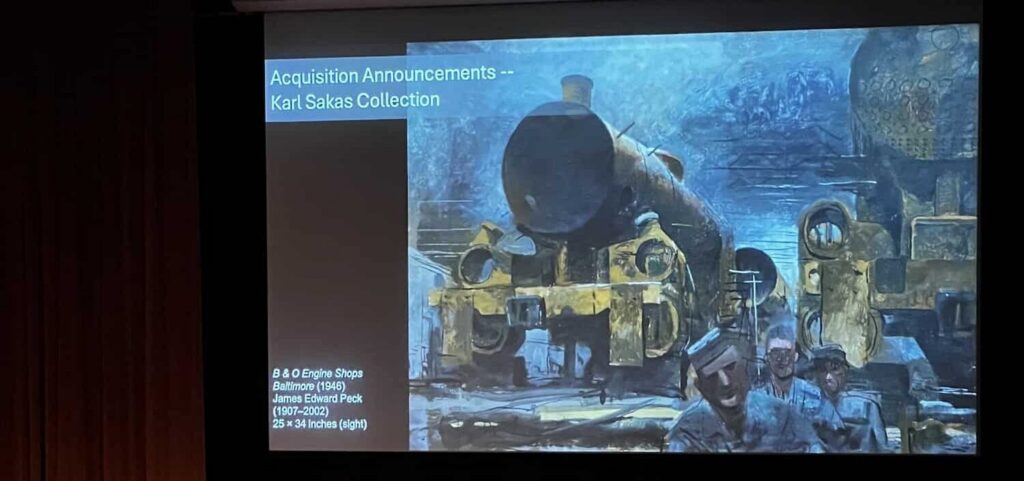
1. Consider the Center for Railroad Photography & Art (CRP&A)
My top recommendation for exploring the donation of original railroad artwork is the Center for Railroad Photography & Art (CRP&A).
Founded in 1997, CRP&A is a national nonprofit dedicated to preserving and presenting significant images of railroading. Its work includes a professional archival program, exhibitions, publications, research, and educational events.
The Center maintains archival facilities in Madison, Wisconsin. It also organizes traveling exhibitions that bring railroad art and photography to audiences across the country. Its endowment and membership base add long-term stability.
This is important because collecting objects and preserving them for future generations aren’t quite the same thing. An artwork needs more than a secure room. Ideally, an institution should have the expertise, systems, and resources to document its history, assess its condition, preserve it properly, and make it accessible for research or exhibition.
CRP&A has developed a professional collections-management program, and its interests extend beyond photographs to original railroad paintings, drawings, and other forms of railroad art.
For example, in 2024, the Center received an important collection of original artwork from the long-time publisher of Trains magazine. The Kalmbach Art Collection includes original works by prominent railroad artists, including Howard Fogg, Ted Rose, and Gil Reid.
The Center has also been promised the approximately 250-piece railroad art collection assembled by Peter and Christine Mosse. Selections from that collection appeared in a 2024 exhibition at New York’s Hirschl & Adler gallery.
Why I chose CRP&A for my own collection
I’m building a collection called Between the Lines: People and Places in Railroad Art. It focuses on narrative and social realism—railroads as lived environments shaped by people, labor, and communities. My collection includes works by historic artists such as Reginald Marsh and Howard Fogg, along with contemporary artists like Dennis Ziemienski and Chris Oldham.
I’ve arranged for the core of the collection to eventually go to CRP&A. I chose the Center because its mission aligns with my collecting goals and because I have confidence in its approach to long-term stewardship. I’m also a member and financial supporter of CRP&A and have written for its quarterly journal, Railroad Heritage.
Of course, my own experience doesn’t mean CRP&A is necessarily the best destination for your specific collection. Its acquisition process is selective, as it should be.
How to contact CRP&A about donating artwork
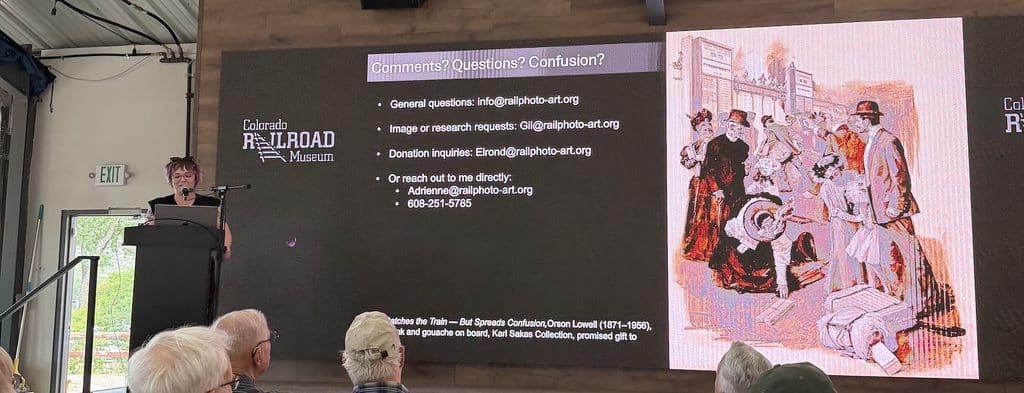
I recommend starting with an email to info@railphoto-art.org. Let them know you’re interested in making a potential donation, and ask for next steps.
CRP&A’s staff can direct you to the appropriate person to discuss whether the collection might fit its mission and current acquisition priorities. You can read more at the Center’s official Donate Materials page.
They might ask roughly what you have, approximately how many pieces there are, the artist’s name(s) if known, and the general condition of the artwork. You might also be ready to share representative photographs.
Important: Contact any institution before shipping or delivering anything. A donation must be reviewed and accepted; sending unsolicited artwork can create problems for everyone.
2. Consider Railroad Historical Societies and Regional Museums
CRP&A isn’t the only possible home for railroad art. If a painting depicts a particular railroad, station, town, or region, a specialized historical organization may be especially interested.
Artwork depicting a particular railroad’s operations could be of interest to a historical society dedicated to that railroad. Do a search for the railroad name plus “historical society.”
Other possibilities include local history museums, university special collections, regional art museums, and transportation or railroad museums.
The key is to find an organization whose mission and collecting priorities fit the work. They will invest significant resources to accession and maintain the work—so strong organizations tend to be picky about what they accept.
Look beyond enthusiasm
One caution: just because an organization is enthusiastic about receiving artwork doesn’t necessarily mean it has the resources to care for it properly. For example, volunteer-run museums and historical societies can do excellent preservation work—but capabilities vary considerably.
To start, I would look for a section on their website about donating objects. Do they talk about accepting in-kind donations? Do they mention art donations? An established donation policy is an encouraging sign—but not everyone will have that.
Before making a major donation, I would ask:
- Does the organization maintain a documented permanent collection?
- Does it have suitable storage and environmental controls?
- Who is responsible for cataloging, conservation, and access?
- Does it have policies governing acquisitions and future deaccessioning?
- How might the artwork be used for exhibitions, publications, or research?
I would also ask whether the institution intends to retain the work as part of its permanent collection or might instead sell it to support operations. “Might sell” isn’t automatically wrong, but you should understand the institution’s intentions before donating.
Even if works stay in their permanent collection, that doesn’t mean they’ll be on view any time soon—or ever. A curator at a major art museum told me that only 5% of their collection is on view. There’s pressure to exhibit what they already own, in limited time and space.
3. Don’t Forget the Materials That Accompany the Art
Art is more than just the artwork itself. This may be the most overlooked part of donating railroad paintings. Suppose you’ve inherited 25 original watercolors and drawings by a railroad artist. You also find a box containing sketches and other ephemera.
It’s tempting to keep the final artworks and discard the rest. Please don’t do that before documenting and evaluating the materials. Those accompanying objects can be extraordinarily valuable.
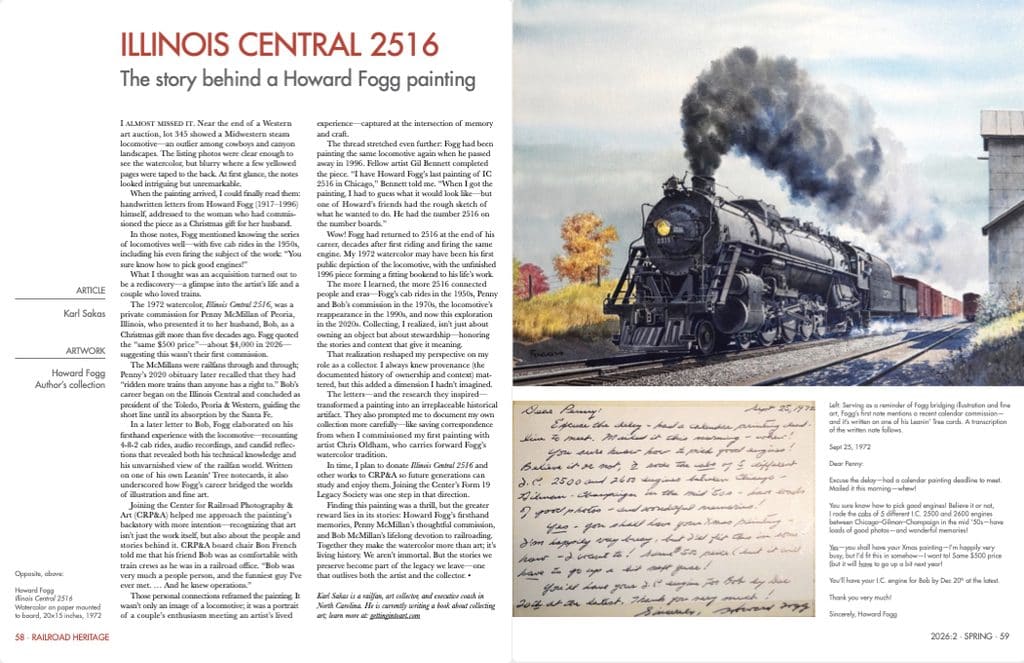
For example, I acquired a 1972 Howard Fogg watercolor depicting Illinois Central locomotive 2516. The back held handwritten letters from the artist to the family who commissioned it. The correspondence revealed that Fogg had personally ridden—and even shoveled coal on—locomotives in the same series. It also documented the painting’s origin as a Christmas gift.
Those letters transformed my understanding of the artwork. What might otherwise have been a beautiful locomotive watercolor became something much more meaningful—a documented connection between the artist, his subject, and the people who commissioned the painting. I subsequently researched the story and wrote about it for Railroad Heritage.
Other materials worth preserving may include preliminary sketches, photo negatives, color slides, diaries, newspaper clippings, records of commissions, and handwritten notes. These materials can explain who created the art, why it was created, what it depicts, and how it came to be in your family’s possession.
If you have accompanying railroad photographs, CRP&A also considers photographic collections, including smaller or curated selections. The Center’s current guidelines explain its different acquisition categories.
Don’t assume a box of slides or negatives is worthless just because the images haven’t been digitized. But a well-documented collection tends to be smoother for everyone than thousands of unlabeled Kodachrome slides.
4. Document the Collection Before Making Any Decisions
You don’t need to create a museum-quality catalog before contacting an institution. But a basic inventory helps enormously.
- Start by photographing each artwork—including the front, back, signature, inscriptions, labels, and frame.
- Record the artist’s name, title or subject, approximate date, medium, dimensions, and anything you know about how your family acquired it. If you don’t know a detail, leave it blank—or indicate that you’re making an assumption—rather than guessing.
- Also note any visible damage or other condition issues—such as tears, staining, warped supports, cracked paint, or evidence of water exposure.
- Keep any original letters, receipts, and related documents identified with the artwork they concern.
For a large collection, you can start with a representative group of images rather than documenting every piece in detail immediately.
This preliminary work makes it easier for museums, archives, appraisers, auction specialists, and future family members to understand what you have.
Don’t attempt restoration yourself
Be careful. Until you’ve obtained professional guidance, avoid cleaning paintings, applying tape to torn artwork, removing old mounts, or replacing original frames merely to make the work look more presentable. This can introduce hundreds or thousands of dollars of avoidable damage.
A conservator can help assess whether a problem requires immediate stabilization or can safely remain as-is. Some restoration treatments can be costly—or cause irreversible damage if performed incorrectly. And remember: a painting can have historical or artistic importance even when its condition is imperfect.
The American Institute for Conservation (AIC) shares conservation resources on its website—and a Find a Professional search tool.
5. What If You Want to Sell Some or All of the Artwork?
Not everyone wants to donate a collection, and that’s understandable.
You may need to settle an estate, divide assets among heirs, or convert artwork into funds for other purposes. Or perhaps you want to donate the most historically significant works while selling others. You don’t have to make the same decision about every piece.
If you decide to sell, there are several potential routes:
- Private sale: Sell directly to an interested collector, potentially avoiding intermediaries but handling the transaction yourself.
- Gallery or dealer: Sell outright to a dealer, or consign the work to a gallery that already has potential buyers.
- Railroad specialty auction: Consider an auction house such as Rail & Road Auctions, which serves railroad collectors and enthusiasts.
- Fine-art auction: Depending on the artist and estimated value, consider auction houses such as Swann, Freeman’s, Bonhams, Sotheby’s, or Christie’s.
- Online marketplace: Sites like eBay can reach railroad enthusiasts, particularly for more modestly valued works.
There are trade-offs among sale price, commissions, timing, and the work required of you. It’s difficult to find a selling method that’s both quick and lucrative.
And remember that a railroad painting’s value depends on more than its subject. The artist, medium, quality, condition, provenance, and market trends all matter.
I’ve written a follow-up article with more detail on choosing a sales channel, researching prices, and avoiding common mistakes: “Where to Sell Railroad Paintings and Art.”
If you think your collection may contain valuable original artwork, consider getting independent appraisal advice before making decisions. The Appraisers Association of America has a Find an Appraiser tool.
6. What About Taxes When Donating Railroad Art?
Donations of artwork to qualifying charitable organizations may provide tax benefits, depending on your circumstances. However, non-cash charitable contributions have documentation and valuation requirements.
The IRS generally requires Form 8283 when you claim a deduction of more than $500 for donated non-cash property. If you claim a deduction exceeding $5,000 for an artwork or group of similar items, you generally need a qualified appraisal. And if you claim a deduction of $20,000 or more for art, you must attach a signed copy of the qualified appraisal to your tax return.
Other rules can affect the deductible amount, especially for art created by the donor or received directly from its creator, or when the recipient organization doesn’t use the artwork in a way related to its charitable mission. And a preliminary auction estimate isn’t necessarily a qualified appraisal for tax purposes.
I recommend consulting an accountant or tax adviser experienced in charitable contributions of art before making decisions primarily for tax reasons.
7. You Don’t Have to Decide Everything Today
If you’ve inherited a large collection, there may be no reason to make immediate decisions. You can begin by documenting what you have, talking with family members, and reaching out to possible institutional recipients.
An institution may be open to an initial conversation even if you don’t intend to transfer the artwork for many years. When CRP&A announced my intended bequest in early 2026, they noted that they “do not expect the collection to come to the Center for some time.”
That’s been my own approach: planning for the eventual stewardship of my railroad art collection while continuing to collect, research, and live with the work today.
Early discussions can help identify the strongest pieces, clarify the documentation that matters most, and establish expectations about the future. If one organization doesn’t want something, another might.
You may ultimately decide to keep some works, donate others, and sell a portion. That’s perfectly reasonable. In the meantime, be a good steward; see the Smithsonian’s article on Caring for Your Paintings. And if your collection includes works on paper, be sure to protect the art from water and UV damage.
Final Thought: Preserve the Stories, Not Just the Paintings
A railroad painting or fine art print is more than a picture of a train. It might record an industrial setting that no longer exists, document how railroad employees worked, illustrate a community shaped by transportation, or preserve an artist’s personal interpretation of a changing world. Some railroad art doesn’t show a train at all, and instead features passengers, workers, or landscapes.
Sometimes its importance isn’t immediately obvious. And sometimes the most meaningful part of an artwork is the story attached to it—the people who created it, commissioned it, owned it, and cared about it.
Whatever you choose to do with your collection, please preserve those stories. The artwork may survive for another century. Good documentation helps future generations understand why the art matters.
SUMMARY: Do you have an original railroad artwork that you’re trying to preserve? Start by photographing the artwork and its accompanying documentation, then contact an institution that may be a good fit. If you found this guide useful, feel free to share it with someone facing the same decision.
About the author: Karl Sakas is a North Carolina-based railroad art collector and writer. His developing collection, Between the Lines: People and Places in Railroad Art, emphasizes narrative and social realism. His writing has appeared in Railroad Heritage, Railroad History, and other publications. His forthcoming fifth book is Getting Into Art: How to Collect Art at Your Own Pace.
Note: This article reflects my personal experience and recommendations as a private collector. I do not speak on behalf of CRP&A or the other organizations mentioned. Donation and acquisition decisions are made independently by each institution. This article isn’t legal, tax, appraisal, or conservation advice. And I don’t claim copyright to any works that aren’t my own.