
Where can I sell railroad paintings and other original railroad art? Options include auctions, dealers, online marketplaces, and more. Your goal is to get in front of the right buyers—which will vary depending on the artist, the artwork’s potential value, and who’s likely to want it. Before selling, consider commissions, timing, workload, and what you’ll actually receive after fees.
Where can you sell original railroad paintings and other train-related artwork?
Maybe you’ve inherited a collection you know little about. Or perhaps you’ve spent decades building a collection yourself, and you’re starting to think about downsizing—or what your family will eventually do with it. Either way, the selling process may bring some surprises.
Your options include railroad specialty auctions, fine-art auction houses, galleries, private collectors, and online marketplaces like eBay. I describe the pros and cons below.
The right choice depends on the artist, the artwork’s condition and potential value, your timeline, and where you’re most likely to find interested buyers. For larger collections, your best choice will likely be a mix of options. You might eventually decide to donate your art (in part or in whole), too.
But before you start contacting auction houses, here’s a story from my experience as a railroad art collector.
A $500 Howard Fogg Painting, Five Decades Later
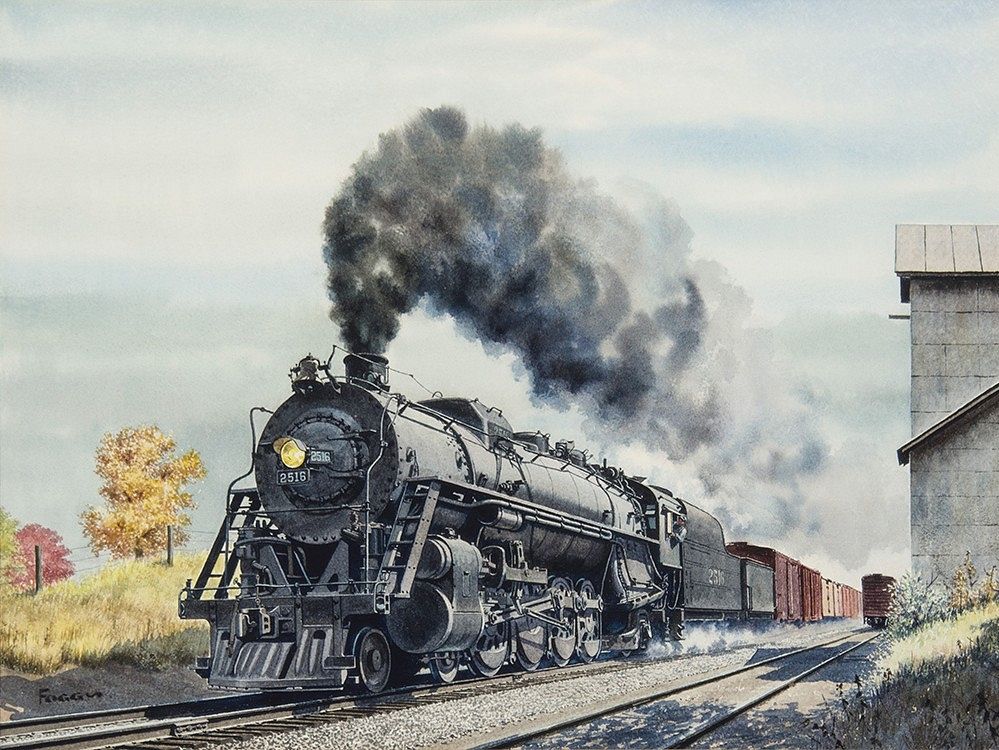
In 1972, Penny McMillan commissioned railroad artist Howard Fogg (1917–1996) to paint Illinois Central steam locomotive 2516 as a Christmas gift for her husband, Bob.
She paid $500—or approximately $4,000 in 2025 dollars.
Fogg was no ordinary railroad painter. Often called the “dean of American railroad artists,” he had worked for locomotive manufacturer ALCO before launching his own studio. His 1,200+ paintings appeared in advertisements, calendars, books, and private collections.
The resulting watercolor is beautiful: a mighty steam locomotive hauling freight through the Illinois countryside, beneath an enormous plume of smoke.
In August 2025, I bought that painting at a Scottsdale, Arizona auction for approximately $1,287, plus shipping. After the auction house’s fees, I suspect the consignor received $900 or less.
Think about that. A painting that originally cost the equivalent of approximately $4,000 may have returned less than $1,000 to its seller, 53 years later.
And here’s an even more sobering way to look at it.
What if the McMillans had instead invested $500 in an S&P 500 index fund? Vanguard launched the first index mutual fund for individual investors in 1976, four years after the commission. Based on Vanguard’s long-term performance figures, that $500—with distributions reinvested—could have grown to something on the order of $100,000 by the mid-2020s, before taxes.
That’s a hindsight comparison, of course. The index fund wasn’t available when Penny commissioned the painting. And the McMillans got something a stock portfolio couldn’t provide: decades of enjoyment from a painting that had personal significance.
Penny was commissioning a Christmas gift, not making a retirement investment. But the financial comparison is sobering.
We hear about paintings selling for millions of dollars. Those are extraordinary exceptions, even in the broader art market. And railroad art is a much narrower market.
Some original railroad paintings have appreciated substantially. Others are more like what antique dealers call “brown furniture“—once expensive, still beautiful, but no longer worth anything close to their original inflation-adjusted cost.
Did the auction consignor miss an opportunity?
My Midwestern watercolor appeared in a Western art auction, surrounded by paintings of cowboys, horses, and desert landscapes.
The auction house had previously handled a large liquidation of a famous collection, including other Fogg works—which may explain why the consignor chose it. But those earlier sales had involved specific works that railroad art fans were eager to buy, which didn’t necessarily translate into an established audience for railroad paintings.
The listing also hadn’t appeared on the auction aggregators I normally monitor. I only found it by chance, through additional research using AI tools. Other than a pre-bidder who didn’t come back for the live auction, I had zero competition. And I was ready to pay more.
I think the consignor picked the wrong auction. But there was also something else. The auction photos showed a few yellowed documents attached to the back of the frame. They looked interesting, but I couldn’t quite read what they said.
When the painting arrived, I discovered several handwritten letters from Fogg himself, plus the original bill of sale. Fogg described personally riding in the cab—and even shoveling coal—in locomotives from the same series during the 1950s. The bill of sale documented the commission and explicitly conveyed copyright and reproduction rights.
For me, those documents made the painting extraordinary. I subsequently researched the story and wrote about it for Railroad Heritage.
I was thrilled with the purchase. But I wonder whether the seller might have done better with a different auction house, one that regularly markets railroad art to railroad collectors.
Perhaps—but there’s no way to know. And that uncertainty is part of the challenge of selling specialized art.
1. Before Selling, Figure Out What You Have
Original railroad art spans a broad range of artists, media, periods, and price points.
An original Howard Fogg watercolor might sell for several thousand dollars. A mass-produced reproduction of the same painting might bring $20. That’s quite a difference.
Start with the basics: artist, title or subject, approximate date, medium, size, and condition. Look for signatures, inscriptions, gallery labels, and any documents that establish the artwork’s history.
If there’s a signature, that helps—although it doesn’t guarantee authenticity. If there’s no signature, try a mix of reverse image search and expert input. Those options don’t guarantee you’ll identify everything, but they’ll identify leads to explore further.
And don’t assume something is original merely because it looks convincing. Here’s an example from my own experience.
My $750 Otto Kuhler mistake
Early in my collecting, I bought what I thought was an original Otto Kuhler lithograph. Kuhler (1894–1977) was a remarkable industrial designer and artist, best known for his railroad streamlining work.
His fine art prints can be collectible—even among non-railroad fans—and I thought I’d found a rare one worth perhaps $3,000. I was thrilled to get it for $750.
The image looked right, and the auction house seemed to have missed that it was Kuhler. I saw what appeared to be an original pencil signature. Excited about the possibility of an overlooked bargain, I failed to inspect the work closely enough.
When it arrived, I got out my loupe—a small magnifying glass.
Oops. The image was halftoned. It was a photomechanical reproduction, not the original lithograph I’d imagined.
The significance of the pencil signature is still unclear, but the work was probably worth closer to $150 than $3,000… and part of that $150 was the nice frame.
To be fair, the auction house hadn’t represented the work as an original lithograph. I tricked myself.
It still looks great, and I enjoy owning it. But it wasn’t the deal I thought I’d found.
I mention this because sellers sometimes make the same mistake in reverse. They assume that anything signed, old, or associated with a famous artist must be valuable.
Not necessarily.
For another example, I knowingly bought a Calder-related reproduction for sentimental reasons. I paid around $200, knowing I wasn’t buying an original $7,000 Alexander Calder work.
There’s nothing wrong with a reproduction. Just don’t confuse it with an original.
Medium and size matter—to a point
Within an artist’s work, an original oil painting may command more than a watercolor, while a watercolor may command more than an editioned print or reproduction.
A signed work may be more marketable than an unsigned one.
But these aren’t universal rules. An excellent watercolor can be considerably more valuable than a mediocre oil painting by the same artist.
Size has its own complications, too. A larger painting may look impressive, yet become harder to sell because of transportation and display requirements. More on that shortly.
2. How Much Is Railroad Art Worth?
There isn’t one market for railroad art.
A collector who specializes in Pennsylvania Railroad locomotives may value a technically precise engine portrait. Someone who collects American Social Realism may care far more about the artist, composition, and human figures.
Both might look at the same painting, but with very different priorities.
In general, value depends on the artist, medium, quality, subject, size, condition, provenance, and actual collector demand.
And remember that a dealer’s asking price isn’t the same as an auction result—which isn’t necessarily the same as what the seller ultimately receives.
I recently exhibited two photos at a major railroad museum. They asked if I wanted to list the photos for sale on a consignment basis. I asked what price ranges people had charged in the prior show. Most were under $500—and for original art in their gift shop, buyers rarely wanted to spend more than $100. Having spent more than $100 on the frames, I decided to mark my photos as “not for sale.”
Check auction records, including Artnet
I subscribe to the Artnet Price Database, which contains more than 18 million auction results. It’s one of my most-used research tools when considering a purchase. Artnet also offers a one-day pass if you don’t need ongoing access.
I start by searching for the artist. If there are auction records, I look at the range of prices, the medium, and the dates of sale. A $12,000 oil painting isn’t necessarily comparable to a $1,500 watercolor or a $300 etching, even when they’re by the same artist.
Then I look at the auction houses. Does one particular house regularly sell the artist’s work? Are results concentrated in a certain region? Are stronger sales associated with certain subjects or periods?
I also look for works that failed to sell. An unsold lot—often described as bought in—can be as informative as a successful sale. It tells you that bidding didn’t reach the required price, although it doesn’t necessarily explain why.
If an artist doesn’t appear at all when you search the database, that may reflect a thin market, low-value auction history, or gaps in coverage. It doesn’t mean the artwork is worthless, but you’re going to have to find comparables elsewhere.
One practical note: Artnet’s fine-art database generally covers lots with estimates of $500 or more (I would try Invaluable or LiveAuctioneers for that).
And pay attention to the search allowances. At the time of writing, Artnet’s one-day pass provides five searches, each covering up to 100 results, for $32.50. I recommend saving the results you need while you have access.
What if the artist isn’t in Artnet?
I’m currently considering bidding on a painting by an artist whose works have appeared at auction with estimates around $400–$600. According to the liquidation auction house’s own history, they’ve sold his work before—for between $50 and $550. The artist doesn’t appear in Artnet.
Perhaps his work sells privately. Perhaps the auction results are too small to appear in the database. Most likely, there’s simply very little secondary-market demand. But I don’t know.
For my own bidding purposes, I’m assuming essentially zero resale value. If I buy the painting, it’ll be because I want to live with it, not because I expect to recover the cost in the future.
That assumption affects my bidding ceiling. It’s also why I wouldn’t recommend paying for an elaborate appraisal of every inexpensive painting in an inherited collection. Sometimes the research and appraisal cost more than the likely sale proceeds.
Even famous artists can decline in value
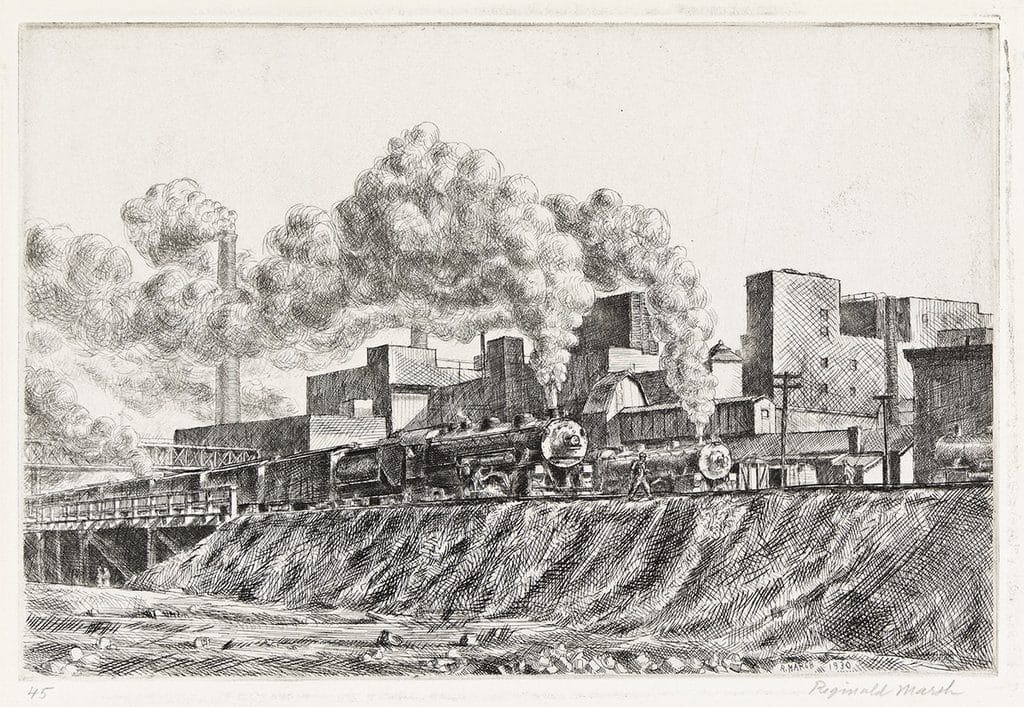
I tracked a Reginald Marsh watercolor that sold for $52,500 in 2013. When the same work returned to auction in 2026, it brought about $18,000.
Instead of going up in value, the price dropped about 65%. Yet notably, the final 2026 hammer price was still 40% above the new high estimate.
A painting can exceed expectations at one auction while selling for far less than it did previously. Historical prices aren’t a promise.
When reviewing repeat sales, check whether the reported figures include buyer’s premiums, and whether the condition or other circumstances changed between sales.
Sometimes there’s a “magic moment”
The reverse can happen, too. I attended an event at a regional fine-art auction house. They were a mid-market firm—neither an international giant nor a high-volume estate liquidator.
A department director shared an unusual example. A painting estimated at roughly $1,000–$2,000 reportedly sold for around $65,000, beating the artist’s previous auction record of approximately $48,000.
She called it a “magic moment.” That’s when two or more well-heeled bidders really, really want the same thing. The price takes off, and suddenly an otherwise ordinary auction estimate looks absurdly conservative.
As a buyer, I’m thinking: that doesn’t sound particularly magical for the winning bidder! But it’s certainly wonderful for the consignor.
The problem is that you can’t plan for a magic moment. You can only put the artwork in a position where interested buyers might find it.
3. Where Should You Sell Railroad Art?
Once you have a reasonable sense of what you own and what it might bring, it’s time to start considering sales channels.
Railroad specialty auctions
For work that primarily appeals to railroad enthusiasts, a specialist auction may be the logical first stop.
My favorite example is Rail & Road Auctions, based in Indiana. They handle railroadiana—including lanterns, signs, builder’s plates, china, and other artifacts—as well as original transportation artwork. I’ve bought from them several times.
The advantage is straightforward: their audience already cares about trains. Indeed, I always look at their digital catalogs. Even when I don’t buy anything, it’s fun to browse because they have unique items.
A technically accurate Howard Fogg locomotive painting may attract more attention there than it would at an otherwise excellent auction devoted to Western landscapes. But that doesn’t guarantee record prices; it depends on who shows up.
As with any auction house, more lead time is better. You might discover that the next suitable sale is several months away—or even a year or more in the future. Ask before you commit.
Fine-art auction houses
For a work with broader art-historical appeal, I’d consider a conventional fine-art auction.
The appropriate house depends heavily on the artist and estimated value.
- Christie’s or Sotheby’s might be possibilities for an important work by an established artist with a substantial international market. In addition to their marquee evening sales, they also offer online-only sales.
- Bonhams, Freeman’s, and Heritage Auctions are other possibilities, depending on their departments and the material they handle.
- For American illustration, prints, and works on paper, I’d investigate Swann. I’ve also encountered relevant works through Rachel Davis Fine Arts, Soulis Auctions, and other regional houses.
I wouldn’t automatically choose the most prestigious house willing to accept the painting. A specialized work can get lost in a large general sale. Conversely, a carefully researched and promoted lot at a smaller auction house may reach exactly the right bidders.
The best auction house isn’t necessarily the biggest one. The best is the one most likely to reach the right buyers for your collection.
Reach out to a few firms. If one proposes a suspiciously high estimate, ask what’s behind that. And if several auction houses decline the work, take that as useful market feedback. You may need to approach a different kind of auction house—or consider a dealer, private sale, or estate liquidator instead.
Watch the auction calendar
A further complication: specialized auctions don’t necessarily happen every month. For instance, Swann has held a dedicated Artists of the WPA auction annually in recent years. The January 2026 sale was its fifth consecutive one.
If you have a suitable WPA-era painting, it could be an appealing addition. But if you’ve missed the consignment deadline, you might be waiting for next year’s sale.
Ask when your painting would actually go to auction. That’s very different from when the auction house can receive it.
Galleries and art dealers
An established gallery may have collectors interested in a particular artist. It might purchase the painting outright—but more often it may offer to sell it on consignment.
That’s where the economics can become unpleasant.
I once asked a reputable gallery about reselling a painting I’d purchased from them. The proposed commission was 40%.
The gallery would offer the painting at its original retail price, and I’d receive 60% if—and when—it sold. I’d also have to pay to ship it back to the gallery. In other words, even if the painting resold for exactly what I’d originally paid, I’d take a substantial loss.
I don’t fault the gallery. It has to pay staff, maintain its space, advertise, and absorb the risk of carrying unsold inventory. They’ve also worked for decades to build their reputation as a place to buy works by their artists.
But this is why “I bought it for $X” doesn’t mean you can necessarily sell it for $X. A gallery might keep a painting for months or years before finding a buyer. And it may never sell.
Before consigning, ask about commission rates, insurance, exclusivity, price reductions, transportation costs, and when you’ll receive payment.
It’s often courteous to approach the original gallery first, particularly if it still represents the artist. But that doesn’t obligate you to accept a proposal that doesn’t work financially.
Online marketplaces such as eBay
Selling directly through eBay or a similar marketplace may make sense for relatively modest works.
You can reach enthusiasts without going through an auction specialist or gallery. You reach an ungated global audience, you have more control over the asking price, and commissions may be lower than your alternatives. But you’re doing all the work: photography, descriptions, buyer communications, payment issues, packing, and shipping.
Don’t forget shipping-damage claims. Even if your listing says you don’t accept returns, damage-on-arrival complaints can trigger eBay’s buyer-protection process. You’ll potentially be dealing with the buyer, shipping carrier, insurance claims, and a returned artwork that may now be worth less than when you sent it.
As a buyer (not on eBay), I recently spent five months dealing with a $328 shipping-damage claim. The dealer wouldn’t reimburse me until the parcel company paid their insurance claim. If I’d known it would require months of back-and-forth, I’d have skipped the claim entirely.
Take good packing photographs, pay extra for suitable materials, and understand the carrier’s insurance rules before shipping.
A listing may also sit there indefinitely. If you’re researching eBay prices, focus on completed sales rather than asking prices. Any seller can list a painting for thousands of dollars… but that doesn’t mean anyone will pay it.
Regional estate auctions and liquidators
Some artwork may be better suited to a lower-cost, higher-volume auction business.
I recently visited an auction house in Queens, New York, to inspect a painting I was considering. I’d arranged the visit during an existing trip via LaGuardia.
The location turned out to be a massive warehouse filled with racks and racks of artwork. An employee led me through a maze of walkways to a particular section of shelving. She rifled through several paintings and held up the one I’d come to see.
I took photos—and I asked if they could send a written condition report.
She paused, apparently surprised by the question. “The condition is what you saw.” Very New York.
I appreciated the directness, but it was a different experience from visiting a fine-art auction showroom. And that’s not necessarily bad.
Some original paintings have extremely limited resale markets. At a certain point, they may be purchased primarily as decoration rather than as recognized fine art. A lower-touch liquidator may be the appropriate place to sell those works, especially when an estate needs to clear a substantial quantity of material.
Just don’t assume you’ll receive extensive research, detailed condition reports, or individualized marketing. Ask what the auction house will actually do.
Selling directly to a private collector
Another option is to approach collectors who specialize in the artist, subject, or railroad depicted. A direct transaction may avoid auction or gallery commissions. It can also be faster, assuming you find the right buyer.
For disclosure, I’m one of those collectors. I occasionally buy original railroad paintings and drawings, particularly works that emphasize people, labor, and the social world surrounding trains. I’m not a dealer or appraiser, and I don’t offer price assessments of works I’m considering buying.
My collection, Between the Lines: People and Places in Railroad Art, is deliberately selective. I regularly pass on excellent railroad artwork that doesn’t fit its focus. For example, I like narrative art, so I primarily buy art that includes people. If a railroad painting doesn’t have people, it would need to be extremely strong in other ways.
If you’re considering selling original railroad artwork, you’re welcome to contact me. I may be interested—or I may be able to suggest other avenues worth exploring.
Either way, I’d encourage you to research the work’s potential value and understand your alternatives before selling.
Selling an entire collection versus individual paintings
What if you have 50 railroad paintings to sell, rather than just one or two?
Selling everything through a single auction house may be convenient. But the house that’s ideal for your Howard Fogg watercolor might not be the best place to sell a Reginald Marsh etching or a painting by an obscure regional artist.
You could split the collection among several auction houses or galleries. That may bring better results for individual works, but it also means more research, contracts, shipping, and waiting.
Ask whether a prospective auction house would sell everything individually, group some pieces into lots, or offer the collection intact.
A particularly strong, coherent collection might interest a buyer or institution as a whole. But don’t assume that 50 paintings are automatically worth more together than separately. A coherent collection may appeal to an institution even without a famous collector’s name attached. Auction houses, however, may find that selling works individually—or in smaller groups—attracts more buyers than offering everything together.
Convenience has value, too. You may decide that getting everything handled in one transaction is worth accepting somewhat lower proceeds.
4. The Costs—and Hassles—of Selling Art
Even after finding an interested auction house or gallery, several things can complicate the sale.
The buyer’s price isn’t the seller’s proceeds
Suppose your painting hammers at $2,000.
The particular auction house charges the buyer a 25% premium, meaning the reported sale price is $2,500. But that’s not necessarily the buyer’s final cost, either.
Suppose the purchase is subject to New York City’s 8.875% sales tax. That’s approximately $222 on the $2,500 subtotal, which includes the buyer’s premium. Now suppose the buyer separately hires an art shipper for $300.
Here’s what happens:
| Transaction | Amount |
|---|---|
| Hammer price | $2,000 |
| Buyer’s premium (25%) | $500 |
| Reported auction price | $2,500 |
| Applicable NYC sales tax (8.875%) | $222 |
| Packing and shipping | $300 |
| Buyer’s total cost | $3,022 |
| Hammer price used for seller’s calculation | $2,000 |
| Seller’s commission (15%) | −$300 |
| Other agreed seller expenses | −$100 |
| Net to seller | $1,600 |
In this hypothetical example, the buyer spends approximately $3,022—while the seller receives $1,600.
Not all the difference goes to the auction house, of course. Some goes to taxes and transportation. Shipping is less when a work is unframed. Fees vary by auction house. And tax treatment varies.
But the larger point remains: when I bid, I’m thinking about the total cost, not just the hammer price. If I have a $3,000 all-in budget for a painting, that might mean capping my bid at $2,000. This affects my bidding ceiling—and ultimately what the seller may receive.
What if the work doesn’t sell?
Auction sellers sometimes insist on a reserve—the minimum price at which the auction house may sell the artwork. If bidding doesn’t reach the reserve, the lot may be bought in, meaning it goes unsold.
Bought-in works can produce great deals for buyers. I’ve bought several artworks after they failed to sell at auction—including an original Otto Kuhler painting that came with a handwritten letter by the artist, describing how he created the work.
I don’t know exactly what those auction houses said to their consignors. But imagine getting a call a few days after an unsuccessful sale: there’s a serious buyer, although the offer is below your original reserve. Would you take it?
You could wait for another auction, perhaps with a lower estimate. But now the work has a publicly recorded unsuccessful sale. Interested buyers may know it didn’t sell the first time. That doesn’t mean anything is wrong with the artwork. Perhaps the reserve was too high, or the right bidders simply weren’t there.
Depending on your motivation, a credible post-auction offer may be more attractive than waiting months, paying for storage or return shipping, and risking another unsuccessful sale.
If you’re consigning, don’t assume that an unsold painting will automatically be offered again at the next auction. Ask what happens afterward.
- Will the auction house try to arrange a post-auction sale with the highest non-winning bidder, or others from their buyer pool?
- Can it hold the painting for another suitable auction in three to six months?
- What if the next opportunity is a year away? Will you need to pay to ship the painting home, store it, and then ship it back for a future sale?
- Are there storage or withdrawal charges?
Fees can quickly eat into the eventual proceeds. And that doesn’t even include the stressful hassle of the uncertainty.
Big paintings can be a problem
I once watched an impressively large railroad painting—approximately 7½ feet by 7½ feet—hammer for just $300.
Why such a low price? Location, location, location. The work was at the consignor’s location in rural Kansas.
A work that large isn’t something you can pack in a reinforced cardboard box and send through UPS or FedEx. You could commission a custom shipping crate—but the crate alone would cost more than $300, much less the freight shipping fees.
Even if an experienced art handler could safely remove the canvas from its stretcher and roll it—which isn’t appropriate for every painting—you’re still dealing with a shipping tube approaching nine feet long. That isn’t an ordinary parcel shipment, either.
A serious buyer would need to arrange a truck or professional art transportation. Someone could love the painting but balk at spending far more on shipping than on the artwork itself. And how many people have a wall large enough to appropriately display a 7½-foot-square painting?
The size and pickup requirements likely narrowed the bidder pool considerably.
Damage creates uncertainty—and uncertainty affects bids
Condition is another factor that can derail an otherwise promising sale.
Works on paper are particularly vulnerable to water damage, staining, improper mounting, and deterioration.
For example, a drawing that’s been laid down—adhered to another support—may present conservation challenges, depending on the adhesive, mounting method, and condition of the paper.
- Some works were intentionally mounted by their artists, and mounting isn’t automatically a defect. But problematic mounting, especially combined with water damage, can make sophisticated buyers cautious.
- I acquired an original drawing for a few hundred dollars that had mounting issues and evidence of past water damage. I didn’t realize I should get a conservation estimate first.
- Afterwards, a conservator quoted nearly $2,500 for treatment. Oof.
If you’re the seller, it’s like selling a house that has a crack in the foundation. Buyers may react to damage in very different ways.
- One person might assume the repair is inexpensive, but demand a substantial discount anyway.
- Another might assume the damage would cost thousands to address—or might prove impossible to repair.
- Many would see the damage and decline to make an offer at all.
If you’re selling a damaged work, you may be competing against those assumptions. The drawing I bought still has artistic and historical interest. And conservation may eventually be worthwhile for reasons other than resale value. But for now, I’ve paused that particular project.
Document the condition accurately. Don’t assume restoration will pay for itself—and definitely don’t attempt amateur repairs. Spending $2,500 treating a $300 artwork doesn’t magically make it worth $2,800.
5. Before Contacting an Auction House, Gallery, or Buyer: A Checklist
You don’t need to create a professional catalog—but a little preparation can save everyone time.
- Decide what you’re optimizing for. Maximum proceeds? Speed? Minimal hassle? Keeping a collection together? If you built the collection yourself, are you selling now, downsizing gradually, or simply planning ahead for your heirs?
- Photograph the artwork. Include the entire front and back, signatures, inscriptions, labels, and any visible damage.
- Record the basics. Artist, title or subject, date, medium, dimensions, and framing information.
- Gather provenance. Receipts, letters, exhibition labels, and commission records can make a meaningful difference.
- Research comparable sales. Use auction databases and public records, while distinguishing originals from editions and reproductions.
- Think through logistics. Where is the work now? Who pays for packing, pickup, insurance, and shipping?
If you’re considering consignment, get the terms in writing. Ask about seller’s commission, reserves, anticipated sale date, marketing channels, insurance, storage, and what happens if the work doesn’t sell.
I’d also ask where the listing will appear. Will it be promoted through LiveAuctioneers, Invaluable, or other platforms that collectors monitor? Will it appear in searchable auction records and alerts?
Those channels matter to me as a buyer. I’ve discovered many works through auction aggregators rather than directly through the auction house’s own website. If potential bidders never hear about the painting, they can’t bid on it.
6. Maybe You Don’t Need to Sell Everything
After researching likely prices, commissions, transportation, and the time involved, you might decide to keep the painting after all. That can be a perfectly reasonable decision.
Perhaps the work would only bring a few hundred dollars. If you still enjoy looking at it, you may get more value from keeping it on your wall. Or perhaps you want to retain a handful of meaningful pieces and find new homes for the rest.
If you’ve spent decades building a collection, there’s something else worth considering: you’re probably the person who knows the most about it. You remember where you found the paintings, why you chose them, which artists you got to know, and which pieces have especially interesting stories. Your heirs may know some of those stories, but probably not all of them—unless you’ve documented them.
Even if you have no plans to sell anytime soon, consider documenting what you own and what matters about it. You can also begin exploring potential buyers or institutional homes long before you’re ready to part with anything.
There’s no requirement that you stop enjoying the art just because you’re thinking about what happens to it eventually.
What about inexpensive reproductions?
Some artwork simply isn’t worth the time and expense of selling. If you’ve inherited a stack of inexpensive framed prints or ordinary reproductions, a charity thrift shop may be the most practical choice.
Organizations such as Goodwill may accept framed art, depending on the location and condition. Someone may be delighted to buy a picture for $5 or $10, even if it’s not worth consigning to an auction house. That seems preferable to throwing away something another person might enjoy—or paying to have it hauled away.
I wouldn’t recommend taking potentially important original railroad art to a thrift shop without first investigating it, though.
What about donating original railroad art?
For historically significant paintings or larger collections, institutional donation may be worth exploring. My top recommendation is the Center for Railroad Photography & Art (CRP&A), a national nonprofit that preserves and shares railroad photography and fine art. I’ve arranged for the core of my own railroad art collection to eventually go to CRP&A.
For more about donating art, see my companion article: “Where to Donate Railroad Paintings and Art (and What to Do Before You Donate).” That article also covers something particularly important: preserving the letters, sketches, photographs, and other documentation that may accompany the artwork.
Final Thought: Find the Right Buyer, Not Just Any Buyer
A painting of a locomotive may have very different appeal to a railroad enthusiast than to someone who collects American art. One buyer might care about whether the artist got the locomotive’s details right. Another might care about composition, brushwork, or the artist’s broader reputation.
Ideally, you want your artwork in front of people who understand why it’s interesting—and who are prepared to pay for it. That may mean waiting for the right auction, working with a gallery, finding a private collector, or accepting that the potential market is fairly small.
And there’s nothing wrong with deciding that the painting is worth more to you on your wall than the money you’d receive from selling it.
My Howard Fogg watercolor is one of the most meaningful works in my collection. I love the painting, the history behind it, and the fact that I was able to recover so much of its story.
I’m delighted I bought it—but the person who consigned it to auction probably wasn’t delighted with the financial outcome. Both can be true.
Art can be deeply rewarding to own without being a particularly good financial investment. Sometimes the real return comes from enjoying it—and helping preserve its story for the person who’ll own it next.
And if you’ve spent a lifetime putting a collection together, making a plan for its future is one more way to care for it.
SUMMARY: Are you thinking about selling original railroad art—or an entire collection? Start by documenting what you own and researching comparable sales. Then compare potential buyers, fees, and timelines. You might decide to sell some works, donate others, or keep enjoying them yourself. If you found this guide useful, feel free to share it with someone facing the same decision.
About the author: Karl Sakas is a North Carolina-based railroad art collector and writer. His developing collection, Between the Lines: People and Places in Railroad Art, emphasizes narrative and social realism. His writing has appeared in Railroad Heritage, Railroad History, and other publications. His forthcoming fifth book is Getting Into Art: How to Collect Art at Your Own Pace.
Note: This article reflects my personal experience and recommendations as a private collector. I’m not a professional appraiser or art dealer. This article isn’t legal, tax, appraisal, investment, or conservation advice.